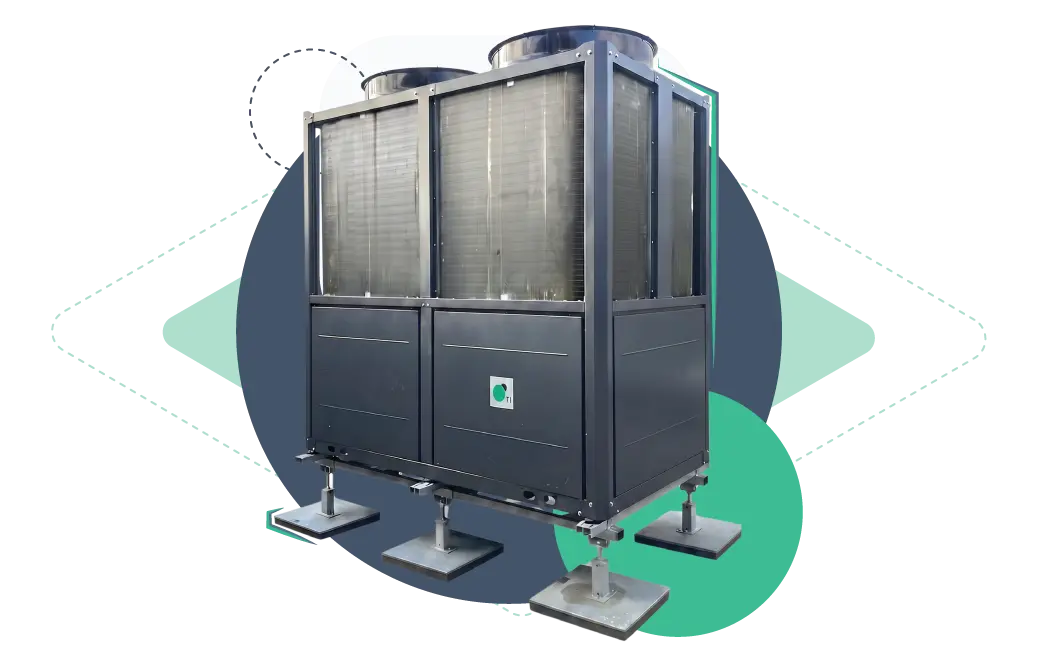
An air to water heat pump uses a vapour-compression refrigeration cycle to extract latent heat from outdoor air — even at sub-zero temperatures — and delivers it as hot water into a building’s heating and domestic hot water circuits.
Unlike gas boilers, which burn fuel to generate heat, heat pumps move existing thermal energy. This fundamental difference is what makes them central to building decarbonisation: as the electricity grid decarbonises further, the carbon intensity of a heat pump continues to fall without any change to the installed system.
Why this matters for decarbonisation
Gas heating accounts for a significant proportion of operational carbon in commercial buildings. Air to water heat pumps offer the most feasible and cost-effective retrofit pathway for buildings already on district heating distribution networks or wet radiator systems — without requiring structural interventions.
Education Estates
School and university buildings benefit from predictable heat demand profiles that align well with heat pump operational characteristics. EPC improvements support Public Sector Decarbonisation Scheme funding eligibility.
Commercial & Office Buildings
Multi-tenanted commercial assets face increasing pressure from EPC requirements and ESG reporting. Air source installations can be positioned externally, minimising floor space loss and disruption to occupiers.
Retrofit Over Replacement
Air to water systems are designed to integrate with existing pipework distribution. In many cases, operating alongside existing plant during a phased transition reduces project risk and client disruption.
Key Benefits
Engineering & ESG Outcomes
The value case for air to water heat pumps spans both operational performance and long-term asset strategy. These are the outcomes our engineering assessments consistently validate.
Carbon Reduction
Eliminates direct gas combustion on site. Lifecycle carbon continues to fall in line with grid decarbonisation, improving EPC ratings and contributing to net zero targets under ESOS, MEES, and ESG reporting frameworks.
Operational Efficiency
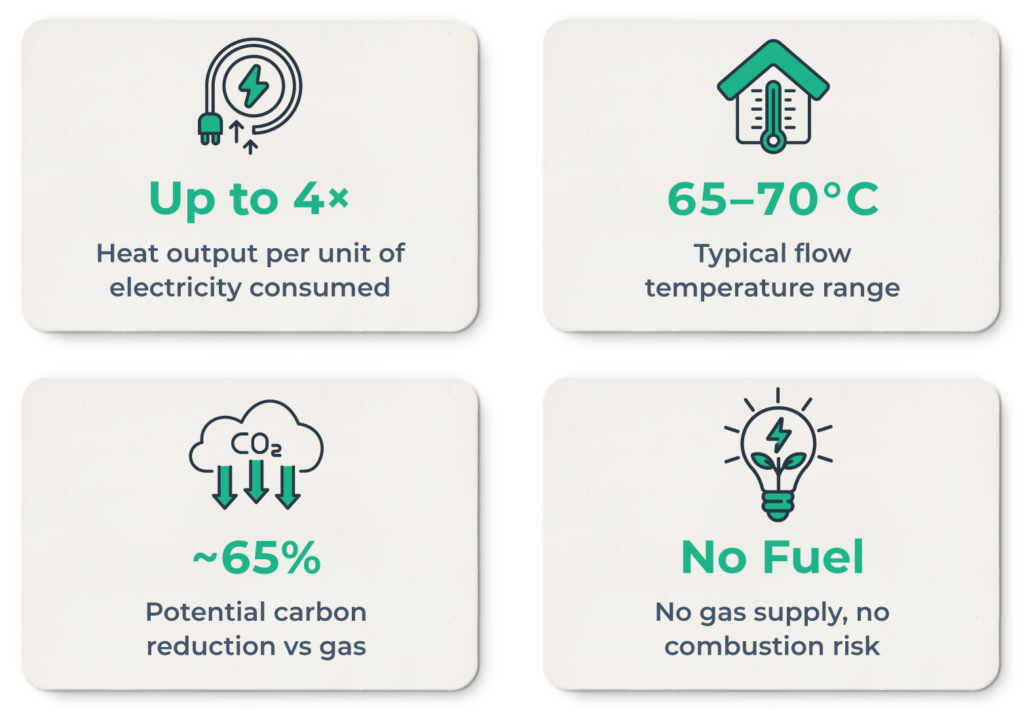
Seasonal COP in the range of 2.5–4.0 means each unit of electricity input delivers multiple units of heat output — materially reducing energy bills relative to direct-fired alternatives at current UK energy price ratios.
Infrastructure Compatibility
Designed to connect to existing wet distribution systems. No mandatory immediate change to emitters, pipework, or building fabric in many retrofit scenarios — lowering capital and disruption risk.
Reduced Regulatory Exposure
Supports compliance with MEES minimum EPC requirements, Streamlined Energy & Carbon Reporting (SECR), and Green Lease obligations increasingly demanded by institutional tenants.
Asset Value Retention
Buildings with demonstrably lower operational carbon and energy costs command stronger occupancy, attract sustainability-aligned tenants, and are better positioned against future stranded asset risk.
Technical Features
System Specification Overview
The following outlines the principal technical characteristics common to the air to water heat pump systems TI specifies and integrates. Exact parameters are confirmed through site survey and feasibility assessment.
Feature
Specification Range
Engineering Note
Heat Source
Outdoor ambient air
Operational from approximately –20°C depending on unit specification. Cold-climate variants available for northern exposure sites.
Flow Temperature
35°C – 70°C
Standard range supports underfloor, fan coil, and radiator systems. Higher flow temperatures may reduce COP — assessed on a per-project basis.
Seasonal COP
2.5 – 4.0 (SCOP)
Varies with ambient conditions, flow temperature, and usage profile. Confirmed via BSEN 14825 or equivalent site modelling.
Refrigerant
R290, R32, R454B
Low-GWP options available. R290 (propane) natural refrigerant preferred for ESG-aligned specifications where installation constraints permit.
Capacity Range
20 kW – 2 MW+
Modular and cascade configurations for larger buildings. Multiple units staged for load-following efficiency and redundancy.
Controls Integration
BMS / SCADA
Compatible with Modbus, BACnet, and KNX protocols. Supports demand-side response and time-of-use tariff optimisation when paired with battery storage.
Noise Output
45–65 dB(A) at 1m
Planning and acoustic screening requirements vary by location. Assessed as part of site feasibility. Scroll and twin-rotary compressor types available for noise-sensitive sites.
Applications
Typical Deployment Contexts
Air to water heat pumps are the most widely applicable decarbonisation technology across the UK built environment. TI has assessed and delivered projects across the following building types.
Primary & Secondary Schools
Suitable for Public Sector Decarbonisation Scheme (PSDS) funded retrofit. Predictable term-time demand, external plant positioning on rooftop or plant room externals.
Commercial Office Blocks
EPC improvement for MEES compliance. Tenant ESG requirements increasingly driving landlord upgrade cycles.
Public Sector Estates
Local authority, NHS, and central government properties targeted under PSDS and Net Zero Estate programmes.
Purpose-Built Student Accommodation
High occupancy density, consistent heat demand profiles, strong commercial incentive from ESG-driven investor requirements.
Mixed-Use Residential
Block-level systems serving multiple apartments, reducing per-unit installation cost and complexity.
Industrial Light-Use Premises
Warehouse offices, light industrial units with space heating requirements. Subject to feasibility assessment of thermal envelope.
System Integration
How It Fits Into a Wider Decarbonisation Strategy
Air to water heat pumps are the most broadly applicable decarbonisation technology in the UK built environment — but realising the carbon and cost benefit depends on integrating the heat pump with the building’s existing distribution, controls, and on-site generation. TI’s approach solves this by design.
1
Site Assessment
Thermal demand modelling, grid capacity review, building fabric analysis.
2
Heat Pump System
Air source unit connected to existing hydronic distribution. Sized to meet baseload demand.
The following ranges are indicative. Confirmed performance figures are derived from site-specific feasibility modelling. TI does not publish generic guarantees.
2.5–4.0
Seasonal COP
Heat delivered per unit of electricity consumed (SCOP, EN 14825).
Site-specific
35–70°C
Flow Temperature
Range accommodates radiators, underfloor, and fan coil units.
Confirmed on survey
Up to 65%
Carbon Reduction
Vs gas-fired equivalent at current UK grid carbon intensity.
Grid-dependent
−20°C
Min. Ambient
Operational range for cold-climate specification units.
Site-specific
Ready to assess your building?
Our engineering team provides no-obligation feasibility assessments that establish technical viability, carbon savings, and investment return — before any procurement decision is made.