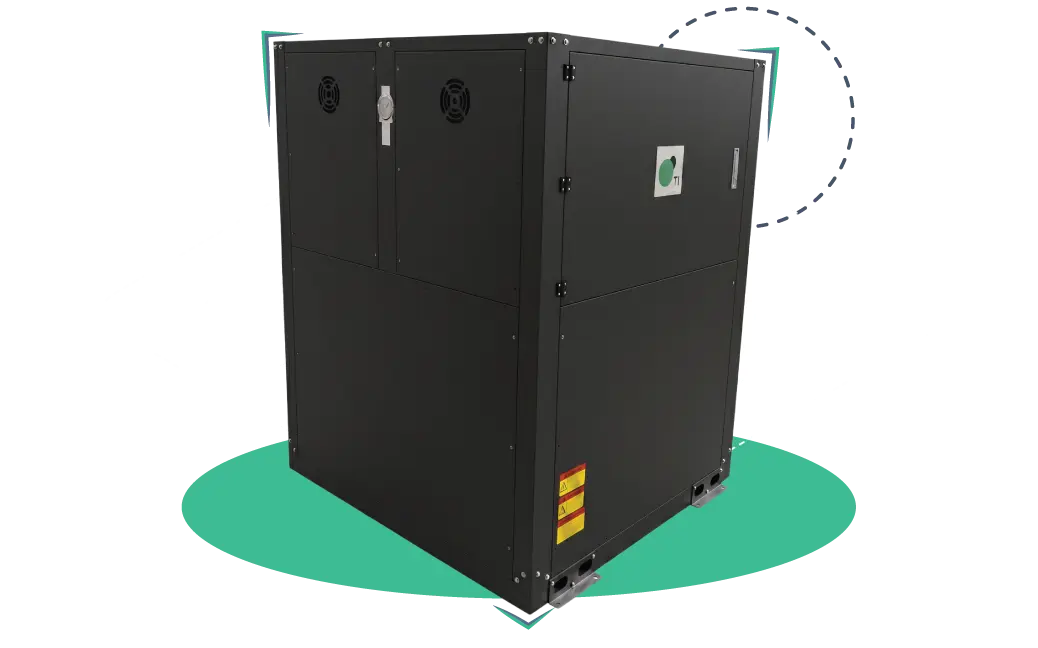
A water to water heat pump operates on the same refrigeration cycle as other heat pump types, but uses a liquid as both its heat source (the evaporator side) and heat sink (the condenser side). The source water may come from a ground loop, a surface water body, a cooling tower circuit, or — in more complex building systems — from a recirculating ambient loop shared across multiple units.
Because water maintains a far more stable temperature than outdoor air, these systems deliver higher and more consistent efficiency across the heating season. This makes them particularly well-suited to larger buildings or campuses where the capital investment in a ground source field or water abstraction system is justified by the scale of heating and cooling demand.
Why this matters for decarbonisation
In buildings with significant simultaneous heating and cooling requirements — hotels, hospitals, mixed-use schemes — water to water systems enable heat recovery across zones, dramatically reducing the total energy input required. This integrated approach reduces both carbon output and peak electrical demand, supporting grid stability and reducing exposure to grid upgrade requirements.
Ground Source / Bore Field
Closed-loop pipework buried in the ground extracts stable 8–12°C heat from the earth. Highly efficient; requires site survey and geological assessment to confirm bore field viability.
Surface Water / Aquifer
Rivers, lakes, or abstracted groundwater serve as abundant low-carbon heat sources. Subject to Environment Agency abstraction licensing and thermal plume impact assessments.
Building Ambient Loop
In multi-zone buildings, individual water to water units connect to a shared ambient temperature loop — enabling each unit to either take or reject heat from the loop depending on local zone demand.
Key Benefits
Engineering & ESG Outcomes
Water to water systems offer a distinct performance advantage over air source where source conditions are available. The following outcomes are characteristic of well-designed installations.
Superior Year-Round Efficiency
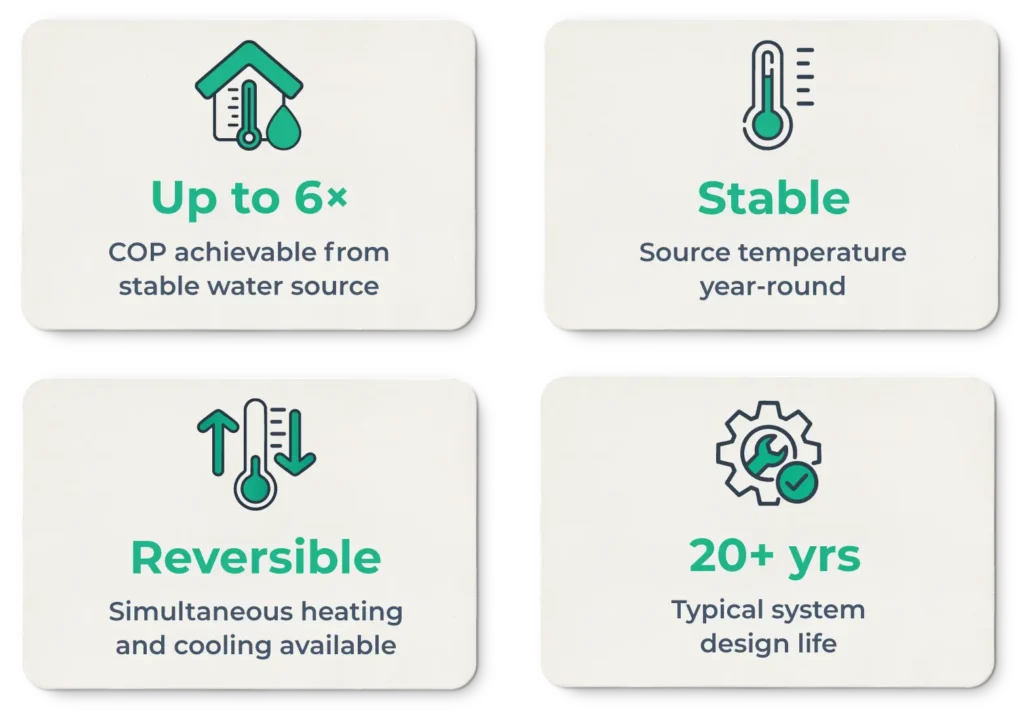
Stable source temperatures in the 8–15°C range allow COPs significantly higher than air source — particularly during winter peaks when air source efficiency degrades and heating demand is greatest.
Simultaneous Heat Recovery
Buildings with concurrent heating and cooling zones — such as hotels, hospitals, and data-centre-adjacent facilities — can recover waste heat and use it productively, achieving effective COPs that can exceed 6.
Reduced Peak Electrical Demand
Higher efficiency means lower electrical input for the same heat output — reducing peak grid import and potentially eliminating the need for DNO capacity upgrades that can cost £100k–£500k+ on commercial sites.
Long Asset Life & Low Maintenance
Ground and water loop components have design lives of 50+ years. Above-ground mechanical plant is designed for 20+ year operating life with regular service intervals — reducing lifecycle capital expenditure.
No Visible External Plant
Unlike air source, the heat exchange infrastructure is buried or in plant rooms — eliminating planning, acoustic, and aesthetic constraints common on heritage or dense urban sites.
Technical Features
System Specification Overview
The following covers the main technical parameters for water to water heat pump systems. All figures are indicative; site-specific confirmation through hydrogeological and thermal survey is required prior to design.
Feature
Specification Range
Engineering Note
Heat Source Type
Ground / water loop
Closed-loop bore field, open-loop abstraction, surface water, or building ambient loop. Source selection determines permitting requirements and capital cost structure.
Source Temperature
4°C – 20°C
Ground source typically 8–12°C year-round in UK. Surface water varies seasonally. Lower source temperatures reduce COP; system optimisation targets maximising source temperature at all times.
Heating COP
3.5 – 6.0+
Peak COP when source and sink temperatures are favourable. SCOP confirmed via BS EN 15879 or project-specific simulation modelling.
Flow Temperature
35°C – 80°C
Range depends on unit specification. High-temperature variants available — see High Temperature Heat Pump section for details above 70°C.
Cooling Mode
Reversible / 4-pipe
Reversible cycle for heating-dominant buildings. Four-pipe heat pump configuration for simultaneous heating and cooling applications. Heat recovery mode delivers highest whole-system efficiency.
Capacity Range
50 kW – 5 MW+
Modular plant configurations. Multi-unit cascade arrangements are standard for commercial scale. Allows N+1 redundancy and partial-load optimisation.
Refrigerant
R134a, R513A, R1234ze
Low-GWP options available and increasingly standard. HFO refrigerants (R1234ze) preferred in new specifications for future F-Gas compliance.
Applications
Typical Deployment Contexts
Water to water installations are most justifiable where scale of demand, site constraints, or performance requirements rule out air source alternatives.
Hospitals & Healthcare
24/7 simultaneous heating and cooling loads make heat recovery configurations highly effective. Redundancy requirements align with multi-unit cascade design.
Hotels & Hospitality
Domestic hot water demand combined with guest room heating and conditioning creates ideal heat recovery opportunity across a shared water loop.
University Campuses
Campus-scale bore fields serving district heat networks, with laboratory and data-centre cooling loads providing heat recovery opportunities.
Large Mixed-Use Developments
New-build and major regeneration schemes where a centralised plant strategy is planned from the outset. Bore fields sized to development heat demand from design stage.
Waterfront & Riverfront Sites
Open-loop surface water abstraction where EA permitting is achievable. Significant source capacity with minimal land requirement.
Industrial Process & Manufacturing
Process cooling or heating loads with stable demand profiles. Waste heat from process loops can be upgraded and redistributed via water to water configuration.
System Integration
How It Fits Into a Wider Decarbonisation Strategy
Water to water heat pumps sit at the centre of a campus or building-wide low-carbon energy system. TI designs these as integrated energy platforms, not standalone equipment replacements.
1
Source Survey
Thermal demand modelling, grid capacity review, building fabric analysis.
2
Ground / Water Loop
Bore field, abstraction infrastructure, or ambient building loop installed and commissioned.
3
Heat Pump Plant
W2W units deliver heating and / or cooling to building distribution circuits. Cascade configuration provides redundancy.
4
Energy Management
BMS optimises load distribution, time-of-use tariff response, and heat recovery across zones.
✓
Optimised Carbon & Cost
Heat recovery across zones maximises effective COP. Full M&V reporting delivers verified carbon savings.
Performance Data
Indicative System Performance
Performance is highly dependent on source conditions, flow temperatures, and load profile. These figures represent indicative ranges confirmed through TI’s feasibility modelling process.
3.5–6.0+
Heating COP
At design conditions with stable source temperature.
Site-specific
8–15°C
Source Temperature
Typical UK ground and groundwater temperature range.
Confirmed on survey
Up to 75%
Carbon Reduction
Vs gas-fired equivalent, dependent on grid carbon intensity.
TI's engineers carry out comprehensive source feasibility studies — including ground thermal modelling, hydrogeological assessment, and regulatory pathway review — before any design commitment is made.