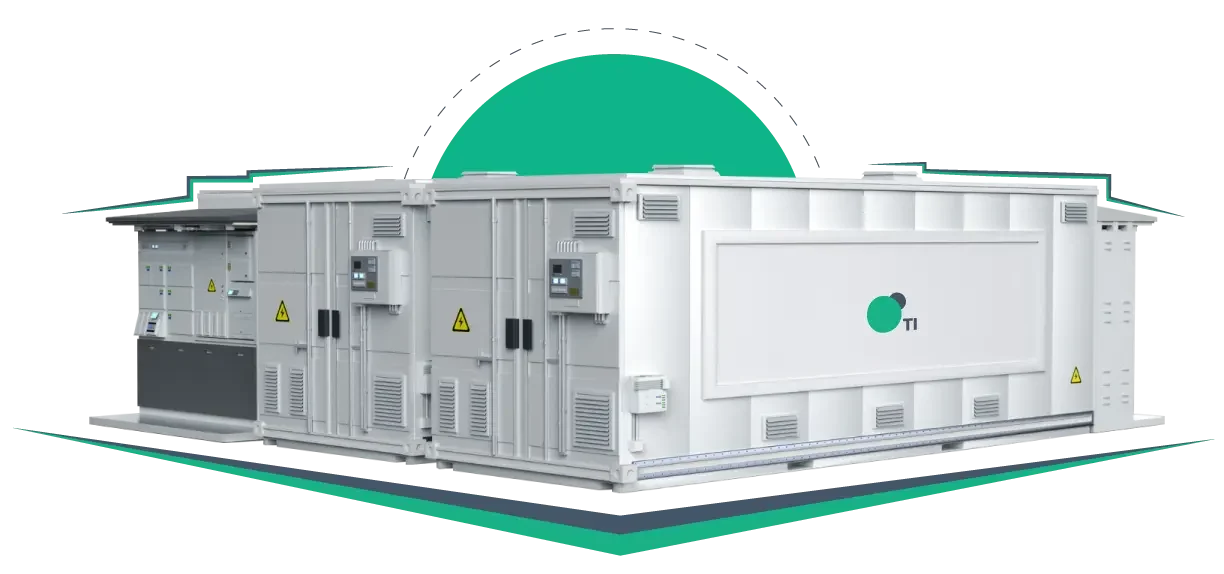
Containerised, liquid-cooled LFP storage that banks low-cost and solar energy and releases it when it is most valuable — cutting demand charges, adding resilience, and unlocking multiple grid revenue streams.
A BESS stores electricity in lithium-iron-phosphate (LFP) batteries and discharges it on demand. Our preferred solution is a fully integrated, liquid-cooled AC block — battery, cooling and power-conversion built into one 20-ft container — that installs faster and costs less than assembling separate parts. Blocks stack from a few MWh to hundreds of MWh, pair naturally with solar PV and EV charging, and are run by a single energy-management system that can stack several revenue streams, depending on system size and market access.
The storage unlock
Built for revenue, resilience and safety
5 MWh
Per AC block
5,015 kWh of usable energy in a single 20-ft container.
2.5 MW
Rated power
Up to 2,500 kW per block; stack to 25 MW and beyond.
20 yr
Design life
Long-life LFP with ~80% capacity retained at year 10.
LFP
Safe chemistry
Liquid-cooled, with multi-level fire protection built in.
Engineering & ESG outcomes
Why battery storage
Several revenue streams
Energy arbitrage, frequency response, capacity-market payments and balancing services — stacked by one smart controller where system size and market access allow.
Grid upgrade often avoided
Shave peak demand so you can add EV chargers, heat pumps and new load without a costly DNO connection upgrade.
Safe, long-life LFP
Liquid cooling and multi-level fire protection, with ~80% capacity retained at year 10 and a 20-year design life — capacity can be maintained through augmentation.
Integrated AC block
Battery, cooling and power conversion in one container — faster, cheaper installation and a smaller footprint.
Modular & solar-ready
Stack from a few MWh to hundreds of MWh and pair with on-site solar PV and EV charging for a low-carbon site.
Two configurations
Power vs energy — side by side
The same 5 MWh container, tuned two ways. Choose more power for fast grid services, or longer duration for energy shifting — or mix both across a site.
High Power
2-Hour Power Block
2,500 kW · 5,015 kWh
Rated power
2,500 kW
Rated energy
5,015 kWh (≈ 5 MWh)
Discharge duration
≈ 2 hours
Cell chemistry
LFP — lithium iron phosphate
AC output
690 V · 3-phase · 50 Hz · transformerless
Cooling
Cell-level liquid cooling.
Enclosure
20-ft · 6,058 × 2,438 × 2,896 mm
Protection
IP55 · −30 to +50 °C
Design life
Up to 20 years
Best for:frequency response, peak shaving and supporting EV fast-charging.
Long Duration
4-Hour Energy Block
1,250 kW · 5,015 kWh
Rated power
1,250 kW
Rated energy
5,015 kWh (≈ 5 MWh)
Discharge duration
≈ 4 hours
Cell chemistry
LFP — lithium iron phosphate
AC output
690 V · 3-phase · 50 Hz · transformerless
Cooling
Cell-level liquid cooling.
Enclosure
20-ft · 6,058 × 2,438 × 2,896 mm
Protection
IP55 · −30 to +50 °C
Design life
Up to 20 years
Best for:energy shifting, solar time-shift and capacity-market contracts.
Typical deployment contexts
Where it fits
One modular building block that scales from a single commercial site to grid-scale storage.
Grid-scale & utility
Multi-MWh installations providing arbitrage, balancing and capacity to the wholesale market.
Commercial & industrial
Peak-demand shaving and back-up for factories, data centres and large estates.
Solar-plus-storage
Bank surplus solar generation for use after dark instead of exporting it cheaply.
EV charging support
Buffer high-power DC charging so a site fast-charges without a grid upgrade.
Microgrid & back-up
Keep critical loads running through outages and enable islanded operation with the appropriate switchgear and controls
Frequency & balancing
Sub-second response to grid signals for contracted ancillary-service income.
The TI integrated approach
Storage engineered around your site and your returns
We size and integrate storage to your load profile and revenue goals — not just drop in a box.
1
Power audit
Assess supply, demand profile, spare capacity and the highest-value opportunities on site.
2
Storage sizing
Balance power against duration (2 h vs 4 h) to match grid services, bills and payback.
3
BESS AC blocks
Modular containers delivered, installed and commissioned — scalable as needs grow.
4
Solar PV + EMS control
Integrate generation and a smart controller to stack revenues and maximise self-consumption.
Resilient, revenue-generating storage
Lower energy bills, back-up power through outages, and a clear path to a greater energy independent, low-carbon site.
Value & performance
How a battery earns and saves
Headline figures for a reference 25 MW / 50 MWh deployment (ten AC blocks), and the revenue and savings a BESS can stack.
50 MWh
Reference energy
25 MW
Reference power
80.4%
Capacity · year 10
20 yr
Design life
Revenue / saving
How it works
Energy arbitrage
Charge when power is cheap or solar is in surplus; discharge at peak price.
Balancing & frequency response
Rapid charge/discharge that helps stabilise grid frequency for contracted income.
Capacity market
Payments for being available to deliver power at system peaks.
Peak-demand shaving
Cut expensive peak-demand and network charges on the site’s electricity bill.
Solar self-consumption
Shift midday solar into the evening peak, when grid power costs most.
Back-up & resilience
Keep critical loads running through grid outages.
Ready to specify or request a quote?
We provide no-obligation feasibility assessments covering technical viability, storage sizing, grid capacity, revenue stacking, carbon savings and ROI for your site.