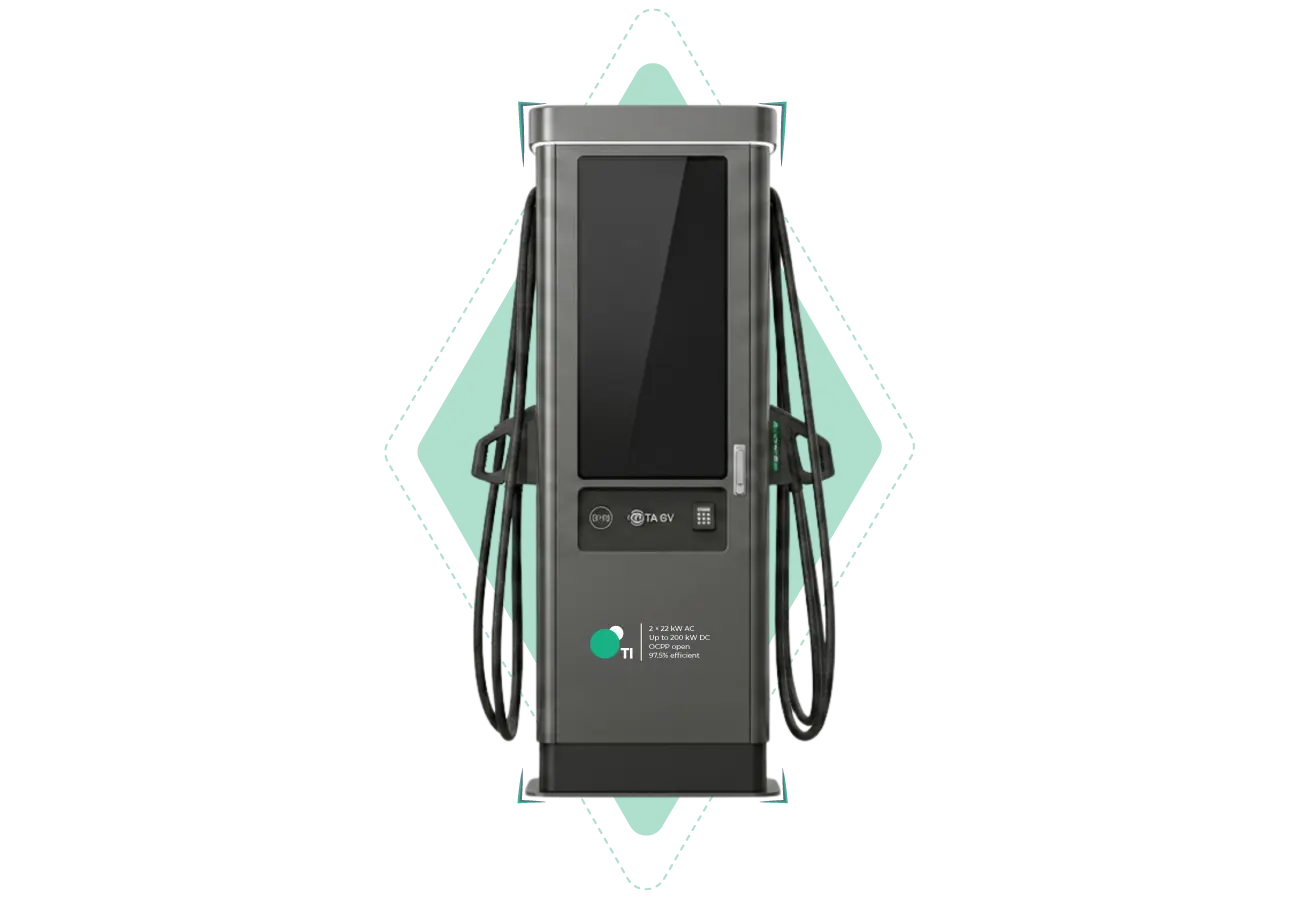
Preferred AC destination and DC fast charging for commercial sites — dual-socket destination charging and modular high-power DC, selected for efficiency, open standards and the lowest cost per charging bay.
A commercial charging system combines AC destination chargers — where vehicles dwell for hours — with DC fast chargers for rapid top-ups, tied together by a smart back-office that balances load across the site. Our preferred equipment pairs a dual-socket AC charger (2 × 22 kW) with a modular DC fast charger (up to 200 kW). Both speak open OCPP, so the site is never locked to a single operator, and both are built to be paired with on-site solar and battery storage to avoid costly grid upgrades.
The charging unlock
Built for throughput, economics and grid-friendliness
2 × 22 kW
Dual-socket AC
One unit charges two vehicles from a single grid connection — a significantly lower cost per bay.
200 kW
Modular DC fast
Start at 100 kW and scale to 200 kW, with dynamic power sharing across two vehicles.
97.5%
Peak DC efficiency
Silicon-carbide electronics cut conversion losses and running cost per kWh delivered.
OCPP
Open protocol
OCPP 1.6 / 2.0-ready and MID-certified metering — vendor-independent billing and control.
Engineering & ESG outcomes
Why this equipment set
Lowest cost per charging bay
Dual-socket AC charges two cars from one unit and one mounting point, cutting hardware and installation cost versus single-socket wallboxes.
Billing-grade, MID-certified metering on AC chargers
Accurate per-driver billing and reimbursement out of the box — no add-on metering hardware required.
Scalable DC with dynamic power sharing
Grow from 100 kW to 200 kW and serve two vehicles from one unit, keeping utilisation — and revenue — high.
Open OCPP — no vendor lock-in
Choose or switch back-office providers freely; integrate with site BMS and IoT for smart tariffs and monitoring.
grid upgrade often avoided
Pair with on-site battery storage and solar to shave peak demand charges and fast-charge in many cases without an expensive DNO connection upgrade.
Two charging tiers
AC and DC — side by side
Two complementary tiers: AC for long-dwell charging at the lowest cost per bay, DC for rapid turnaround where time on site is short.
AC · Destination
AC Destination Charging
Dual-socket wallbox · 2 × 22 kW
Rated output
2 × 22 kW (per socket)
Connectors
2 × Type 2 socket
Charge time
≈ 3 h full charge (60 kWh car)
Metering
MID-certified, per socket (billing-grade)
Load management
Dynamic load balancing across both sockets
Communication
OCPP 1.6 · Wi-Fi / Ethernet · RFID
Grid supply
400 V · 3-phase · up to 63 A / phase
Protection
IP54 / IK10 · −25 to +55 °C
Dimensions
590 × 340 × 230 mm (H × W × D) · wall or pole
Best for:workplaces, retail, hotels and overnight dwell charging.
DC · Rapid
DC Fast Charging
Modular floor unit · up to 200 kW
Rated output
Up to 200 kW (modular 100 → 200 kW)
Power sharing
Dynamic across 2 outlets (2 × 100 kW)
Connectors
2 × CCS2 (optional 3rd CCS2 / CHAdeMO)
Peak efficiency
Up to 97.5% (silicon-carbide)
Charge time
10–80% in ≈ 20–30 min
Output range
150–1000 V · up to 500 A (600 A-ready)
Communication
OCPP 1.6 / 2.0-ready · RFID · contactless
Protection
IP54 / IK10 · −40 to +55 °C
Footprint
2185 × 420 × 663 mm (H × W × D) · floor-mounted
DC times assume the vehicle accepts the full charger output; many vehicles are limited to lower rates.
Best for: rapid top-ups, fleet turnaround, industrial assets and public / highway hubs.
Typical deployment contexts
Where it fits
A single equipment set that scales from a handful of workplace bays to public fast-charging hubs.
Workplaces & offices
Dual-socket AC for all-day dwell charging; billing or reimbursement per employee via MID metering.
Retail & destination
Mix of AC bays and a DC fast unit so shoppers can top up in 20–30 minutes while on site.
Fleet & logistics depots
Overnight AC plus DC for rapid turnaround; smart scheduling within the site power limit.
Hotels & hospitality
AC destination charging as a guest amenity, with a DC unit for quick departures.
Residential compounds
Shared dual-socket AC with per-user access and billing across multiple dwellings.
Public & highway hubs
High-power DC with dynamic sharing and contactless payment for continuous public use.
The TI integrated approach
Charging that works with your grid connection
The biggest barrier to EV charging on commercial sites is rarely the charger — it is the electrical capacity at the meter. We engineer around it.
1
Power audit
Assess the existing supply, spare capacity and peak-demand profile at the site.
2
Load management & BESS
Dynamic load balancing — and battery storage where needed — to add charging without a costly grid upgrade.
3
AC + DC chargers
Deploy the right mix of dual-socket AC and modular DC fast charging for the site's use case.
4
Solar PV + smart control
Integrate on-site generation and OCPP control for the lowest-cost, lowest-carbon energy.
Grid-friendly, future-proof charging
More charging bays within your existing connection, lower demand charges, and a clear path to a fully electrified, gas-free site.
Performance reference
Charging performance & headline figures
Indicative charge times for a typical passenger EV. AC time depends on the vehicle’s onboard charger; DC time is quoted for a 10–80% charge, as speed tapers near full.
2 × 22 kW
AC Output
200 kW
DC Fast Output
97.5%
Peak DC Efficiency
~20 min
DC 10–80% Charge
Vehicle Battery
AC Full Charge (up to 22 kW)
DC 10–80% (up to 200 kW)
40 kWh — city car
≈ 2 h (≈ 4 h at 11 kW onboard)
≈ 12 min
60 kWh — compact / saloon
≈ 3 h (≈ 5–6 h at 11 kW onboard)
≈ 18 min
80 kWh — SUV
≈ 3.5 h (≈ 7 h at 11 kW onboard)
≈ 24 min
Ready to specify or request a quote?
We provide no-obligation feasibility assessments covering technical viability, grid capacity, load management, carbon savings and ROI for your site.