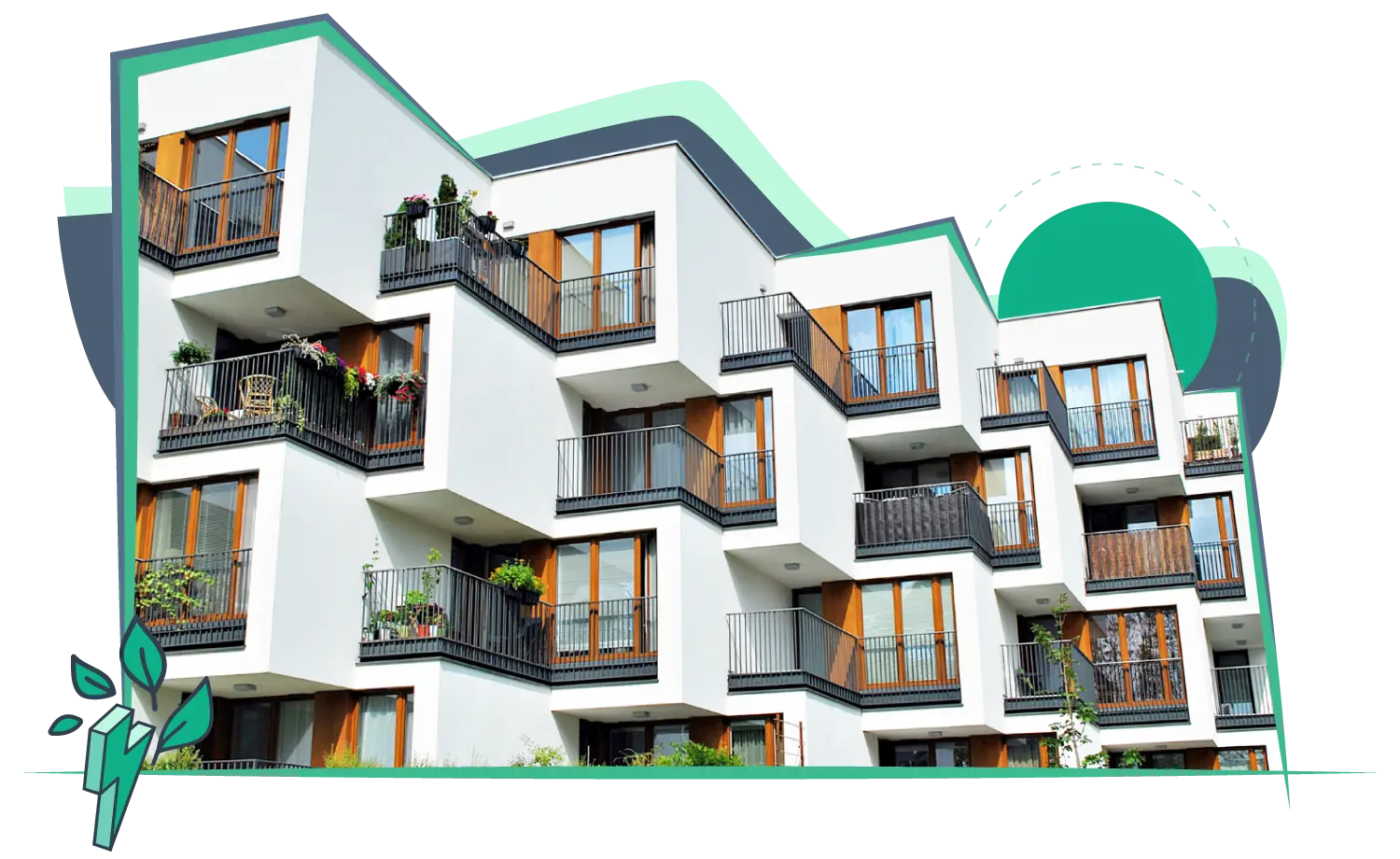
Hot-water-led buildings with limited roof area. The domestic hot water and space heating loads are almost always oversized — so you're paying to heat capacity you never use.
Senior Living / Care
No disruption to vulnerable residents; safe temperature bands guaranteed.
What We Survey
✓ Grid supply capacity
✓ Existing thermal plant
✓ Flow-metered actual DHW demand
✓ AI-assisted analysis of consumption patterns and system sizing
The Solution
Sized to the measured load — not the nameplate
Heat pump
Air-source unit + quick-recovery store, sized to the measured load. ≥60°C hot water, guaranteed.
Engineering Design
Technical design & system optimisation
Space heating
Plant-room controls only — no network changes, no disruption to residents.
Solar
Rooftop solar where roof area allows — cutting electricity costs.
VRF cooling
Zoned, efficient heating and cooling for amenity and communal spaces — comfort without the energy penalty.
The TI Difference
We tie hot-water control to live occupancy data from the building manager
turning chronic over-sizing into a measured, self-improving system.
The Commercial Case
Decarbonisation that pays for itself
Same technology, same minimal-disruption install — a commercial model to suit your balance sheet.
Asset Management
Decarbonising lifts the EPC, protects lettability against tightening MEES, and increases asset value.
The money works two ways
A positive IRR for landlords (recovered through tenants), or significant OpEx savings with a short payback for owner-occupiers.
Heat as a Service
Pay for the heat delivered, not the fuel into the plant.
Solar + EV everywhere
Maximise rooftop solar to cut CapEx and grid draw; add EV charging with a commercial model where it sells.
Funding
Two ways to fund your decarbonisation
Same technology, same minimal-disruption install — a commercial model to suit your balance sheet.
Option 1
Zero CapEx
Fully Funded
TI funds, installs, owns and maintains the system — decarbonisation delivered at no upfront cost, with lower operating costs for your tenants and no capital commitment on your balance sheet.
Option 2
You Own the Upside
CapEx Upfront
You fund the capital and retain 100% of the returns — landlords recharge the value through to tenants; owner-occupiers capture it as OpEx savings with a 5–8 year payback on a 20–25 year asset life.
Ready to decarbonise your residential portfolio?
Book a free desktop decarbonisation review. Tell us about your buildings and we’ll show you what decarbonisation could deliver. No cost and no obligation.
What owners ask us most about decarbonising student accommodation.
Who can help decarbonise student accommodation in the UK?
Terra Instinct decarbonises purpose-built student accommodation (PBSA) with one team covering the business case, survey, design, installation and maintenance. It replaces gas-fired heating and hot water with heat pumps sized to the building’s real demand, and adds solar, batteries and its own energy management system where they pay back. At Vista Square, a 249-bed PBSA scheme in Liverpool, a 180kW air source heat pump system supplies the domestic hot water, and the building is rated EPC A and BREEAM Excellent. Owners can fund the work themselves or choose Energy as a Service, with £0 upfront.
Can a heat pump provide enough hot water for a student block?
Yes, if it is sized to the building’s real hot-water demand and paired with enough stored hot water to cover the peaks. In student accommodation, hot water drives most of the heat load, and demand spikes when residents shower at similar times each morning and evening. Stored hot water covers those spikes, so the heat pump does not have to be sized for the busiest ten minutes of the day. At Vista Square, a 249-bed scheme in Liverpool, Terra Instinct’s 180kW air source heat pump system supplies the domestic hot water.
Why is the hot-water plant in my student block so oversized?
Because it is often sized from design assumptions rather than measured use. Plant sized for a worst case that never happens means owners pay to buy, heat and maintain capacity that sits idle, and repeating that mistake with a heat pump makes the new system bigger and dearer than it needs to be. The fix is to measure how much hot water the building actually uses before choosing new plant. Terra Instinct sizes PBSA heat pumps and hot-water storage to measured demand, so the system covers real peaks without paying for unused capacity.
How do I take a student block off gas without disrupting residents?
Plan the works around the academic year, so the most disruptive jobs happen during the summer vacation when most rooms are empty. High-temperature heat pumps reaching up to 80°C can often reuse the building’s existing risers and emitters, which keeps work inside bedrooms and corridors to a minimum. Terra Instinct phases PBSA retrofits around the academic calendar, with one team responsible from the first survey to long-term maintenance, so residents and the operator deal with a single contractor.
Do I need a grid upgrade to electrify student accommodation?
Often not. Student blocks run around the clock, and electrifying heating, hot water and kitchens adds load, but many buildings have more spare electrical capacity than their original connection agreement suggests. A grid upgrade from the local network operator (DNO) typically costs £100–350k per building, and reinforcement can take 6–10 months before work starts. Terra Instinct measures the real headroom first, then closes any gap with solar, batteries and its own energy management system, so an upgrade is bought only when it pays.
Can I decarbonise student accommodation with no upfront capital?
Yes. Under Energy as a Service, the provider funds, owns and maintains the heat pumps and other plant, and you pay per kWh. That matters in PBSA because with all-inclusive rents the owner pays every energy bill, and energy is around 23% of PBSA operating costs (CBRE). Terra Instinct offers this model alongside client-funded projects, where the owner keeps all of the returns. Either way, one team handles the survey, design, installation and maintenance.