TI delivers end-to-end decarbonisation across multiple asset classes.
Proven across asset classes
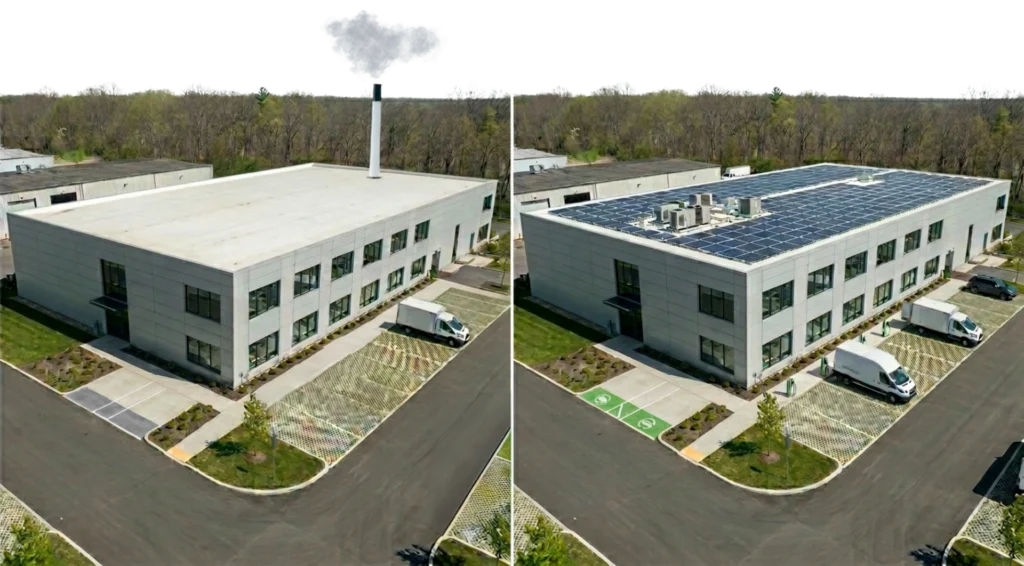
Greening brown assets to unlock long-term value
End-to-end, turnkey delivery — survey & design, supply & install, then manage & maintain — engineered to minimise cost and maximise ROI while making the asset operationally net zero.
High-temperature (80°C) heat pumps
Compatible with your existing heat distribution — no enabling works to existing heating network which keeps CapEx down.
Upgrade with tenants in place
We handle the switch from gas boilers to heat pumps without interrupting day-to-day operations.
Solar PV, battery storage & EV charging
Paired where appropriate to cut grid dependency and add value across the asset.
No costly grid upgrades
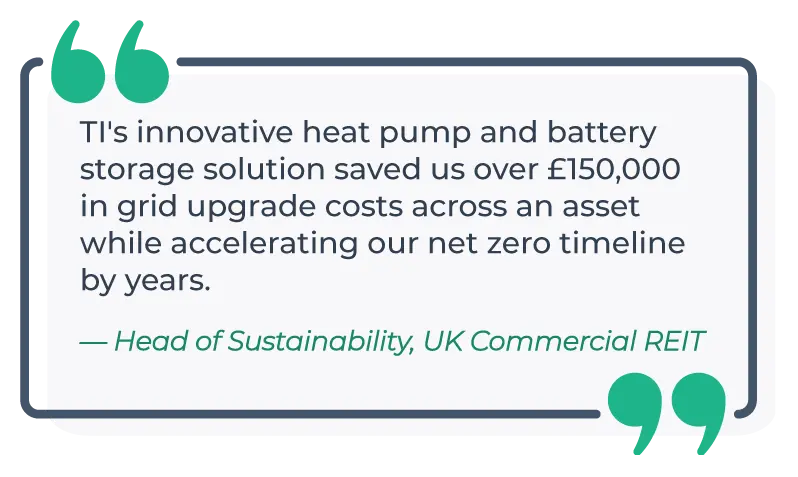
Proprietary integration eliminates the expensive DNO infrastructure upgrades that usually stall these projects.
How it's funded
Two Ways to Fund Your Decarbonisation
Pick the route that suits your balance sheet. Same technology, same minimal-disruption install — different commercial model.
Option 1
Zero Capex
Fully Funded
We bring the investors who fund the capital, so decarbonisation is delivered at no upfront cost to you. TI funds, installs, owns and maintains the system, and generates its return through a commercial model that also lowers tenant opex.
✓ Zero CapEx — funded entirely by TI’s investors
✓ TI funds, installs, owns and maintains the system
✓ Lower operating costs for your tenants
✓ A more marketable, operationally net-zero asset
✓ No capital commitment or technical risk on your balance sheet
Option 2
You own the upside
CapEx Upfront
You fund the capital — directly or through your own investors — and you keep the returns. Landlords recharge the value through to tenants; owner-occupiers capture it as opex savings with attractive payback periods.
✓ You fund the CapEx and retain 100% of the returns
✓Landlords: generate returns from tenants via lower-opex models
✓ Owner-occupiers: 5–8 year payback on a 20–25 year asset life
✓ Long-term opex savings and asset value uplift
✓ Full ownership of the system and all its benefits
Option 1 — Fully Funded
Option 2 — CapEx Upfront
Who funds the CapEx
TI’s investors
You (or your own investors)
Upfront cost to you
£0
CapEx funded by you
Who keeps the returns
TI, via its commercial model
You
Tenant opex
Lower
Lower
Owner-occupier payback
—
5–8 yrs (20–25 yr asset life)
Best for
Zero-capex decarbonisation
Retaining the full financial upside
Why Industrial & Logistics choose TI
Built for Operational Assets
No Grid Upgrade Costs
Proprietary integration of heat pumps, battery and solar eliminates expensive DNO infrastructure upgrades
Minimal Disruption
80°C heat pumps use your existing distribution — we switch you off gas with tenants still in situ
Lower Tenant Opex
Cleaner, cheaper on-site energy reduces running costs across the whole asset
Operationally Net Zero
A future-proofed, more marketable, compliance-ready asset that supports your net zero targets
Ready to Decarbonise Your Industrial Portfolio?
Book a free desktop decarbonisation review. Tell us about your sites and we’ll show you what each funding route could deliver. No cost and no obligation.
What owners ask us most about decarbonising warehouses and logistics property.
Who can help decarbonise a warehouse or logistics building in the UK?
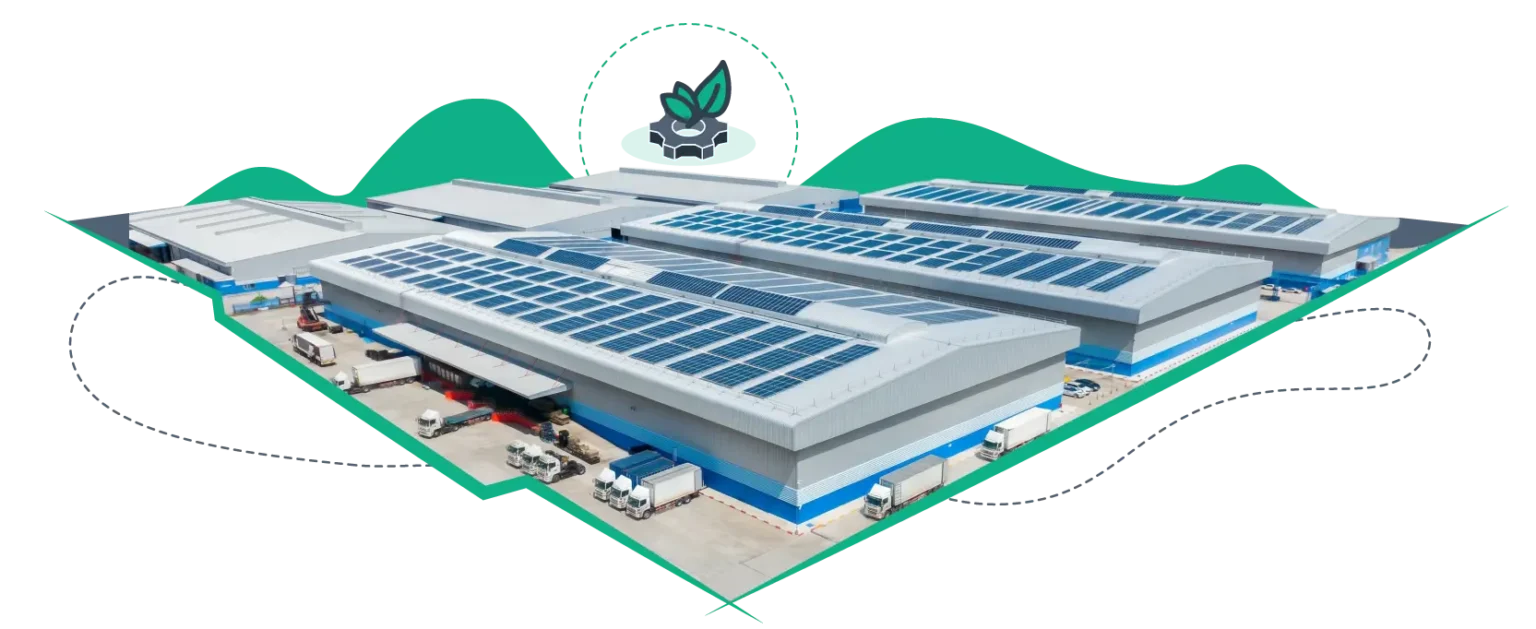
Terra Instinct decarbonises warehouses and logistics estates with one team covering the business case, survey, design, installation and maintenance. It measures each site’s real electrical headroom, then combines rooftop solar, batteries, heat pumps and its own energy management system so the building can electrify without waiting for a bigger grid connection. At Acre Road, a feasibility study proposed a 1,597 kWp rooftop array of 3,073 panels across three warehouse buildings, modelled to generate 1.34 GWh a year. Owners can fund the work themselves or choose Energy as a Service, with £0 upfront.
Often, yes, because large, flat warehouse roofs are one of the biggest untapped solar resources in the UK: fewer than 5% have solar, against around 15GW of potential (UKWA). Whether yours pays depends on the roof’s structure and remaining life, the site’s grid connection and how much of the power the building can use itself. Terra Instinct appraises each roof on structure, grid and yield, and builds only where the numbers work. At Acre Road, a proposed 1,597 kWp array across three warehouses was modelled at a 9.0–9.5% IRR.
Do I need a grid upgrade to add EV charging to a logistics site?
Not always, and waiting for one can cost years: new grid connection offers are now landing in the late 2030s, and a single electric HGV megawatt-charging bay can draw around 1MW. The first step is to measure the headroom the site already has, which is often more than the original connection agreement suggests. Terra Instinct then closes the gap with rooftop solar, batteries and its own energy management system, and applies to the network operator (DNO) only where an upgrade pays. That turns available power into something tenants will pay for.
Yes, if it is privately rented, larger than 1,000 square metres and in England or Wales. In its June 2026 interim response, the government confirmed it intends to raise the minimum standard for these buildings to EPC B from 2031, where cost-effective. Many 1980s and 1990s sheds sit well below that today. The change still needs secondary legislation, with more detail due in a full government response. Terra Instinct works out the lowest-cost route to EPC B for each warehouse, often combining rooftop solar with heat pumps on the existing heating.
Can I put solar on a warehouse with no upfront capital?
Yes. Under Energy as a Service, the provider funds, installs, owns and maintains the rooftop solar and batteries, and the landlord or tenant pays per kWh for the power used. Tenants get cheaper on-site power, and the landlord can gain a new income line without spending capital. Terra Instinct offers this model alongside client-funded projects, where the owner keeps all of the returns. Either way, one team handles the roof survey, design, installation and maintenance.
Do I need to replace old switchgear on an industrial estate before electrifying?
Not on age alone. Ofgem, CIBSE, BEAMA and the HSE all say age is not a reason to replace electrical equipment, and switchgear has a recorded service life of 40+ years against the 25–30 years in standard guide tables (CIBSE Guide M). Older multi-let estates often run on switchgear nobody has opened in decades. Terra Instinct’s intrusive testing opens the panels and measures their real condition, so you replace only what is faulty, and the same testing shows how much headroom you have for electrification.