The short answer
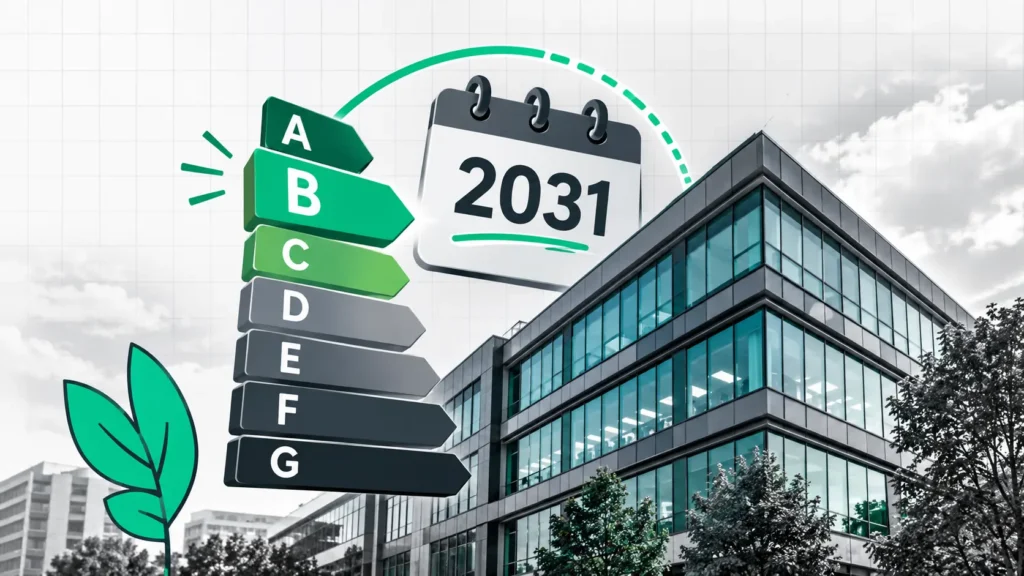
If your building is rented, over 1,000 m² and below EPC B, it has until 2031 to get there. Miss it, and you risk being unable to let it unless you register an exemption.
In June 2026 the government finally set the date. It is later and narrower than the 2030 target owners had planned around, but it is now the date to plan around. The real question is no longer whether the rule applies to you. It is whether five years is enough time to do the work.
What the rule actually says
On 18 June 2026 the government published its interim response on Minimum Energy Efficiency Standards (MEES) for rented commercial property in England and Wales. Four points matter for owners:
- EPC B from 2031 for buildings over 1,000 m², where cost-effective. The original proposal was 2030 for every building.
- No interim EPC C step in 2027. That milestone has been dropped, so there is no early warning before 2031.
- Buildings under 1,000 m² stay at EPC E, with no new deadline for now.
- The seven-year payback test stays. You only have to make improvements that pay back within seven years, and the existing exemptions remain.
The threshold sounds narrow, but it isn’t. Buildings over 1,000 m² are only about 7% of non-domestic properties, yet they use around 60% of the sector’s electricity and 70% of its gas. By TI’s estimate, they cover around 85% of rented commercial floorspace.
Two caveats. The 2031 date is a confirmed policy intention, not yet law: it needs secondary legislation, and a full government response is due later in 2026. Until then, today’s EPC E rule still applies.
The fine is the smallest cost
The penalty for letting a non-compliant building is currently up to £150,000 per breach. The government is still deciding whether to raise it. For most owners, though, the fine is not where the money goes.
- Tenants filter first. Occupiers with their own net zero targets screen out poorly rated buildings before they book a viewing. Voids get longer, and nobody tells you why.
- Lenders price it. Energy performance now feeds into margins, loan-to-value and refinancing terms.
- Buyers discount it. Every offer prices in the cost of the retrofit, and that discount grows each year closer to 2031.
A building that can’t reach EPC B in time loses value well before the deadline, not on it.
Why 2031 is closer than it looks
A typical retrofit takes 12–18 months per building, and it has to fit around lease events and voids. Work backwards from the deadline and the plan looks like this:
- 2026: assess. Find out where each building sits today, what it would take to reach B, and what passes the seven-year payback test.
- 2027–2029: design, procure and deliver. Time the work to break clauses, lease expiries and voids, so you disturb tenants once.
- 2031: comply. Every rented building over 1,000 m² at B, or with a registered exemption.
Contractor and heat pump capacity will tighten every year as other owners do the same maths. Most portfolios need to start assessing now.
Where to start
For most commercial buildings, the biggest single step towards B is taking gas out of the heating. Fabric and lighting help, but the heating system usually decides the rating.
That sounds like a long, disruptive job. It doesn’t have to be. At Radius House, a 41,000 sq ft office in Watford, we replaced the gas boilers with 300 kW of high-temperature heat pumps running at 80°C. The installation took six weeks, needed no grid upgrade and left the tenants undisturbed, and the building’s EPC rating improved.
Three things to do this quarter:
- List every rented building over 1,000 m² with its current EPC rating and its next lease event.
- Check which are within reach of B, and which need heating, fabric or power work first.
- Test the cost against the seven-year payback rule, so you know what you must do and what you can exempt.